If sides of a triangle are 12 cm, 15 cm and 21 cm, then what is the in radius (in cm) of the triangle?
SSC CGL 2018
SSC CGL 2018 Quantitative Aptitude (Maths) Previous Year Questions
500 questions from 5 shifts, sorted by topic, free to practise.
- Questions
- 500
- Shifts
- 5
- Per shift (median)
- 100
- Topics found
- 16
About the SSC CGL 2018 Quantitative Aptitude questions
The quantitative aptitude section tests arithmetic (percentages, profit and loss, interest, ratio, averages, time and work, speed and distance), advanced maths (algebra, geometry, mensuration and trigonometry) and data interpretation. This page brings together all 500 Quantitative Aptitude questions from the 5 SSC CGL 2018 shifts on SarkariPYQ (Tier 2), held between 17 February 2018 and 9 March 2018. A typical shift has 100 Quantitative Aptitude questions. The most frequent question types are geometry (76), profit, loss and discount (50) and algebra (48).
In SSC CGL Tier 1 (computer-based), the Quantitative Aptitude section has 25 questions for 50 marks, 2 marks per question; negative marking: 0.50 marks per wrong answer. The whole Tier 1 (computer-based) paper is 100 questions for 200 marks in 60 minutes. Tier 2 questions are included on this page too. Tier 2 is a longer computer-based exam covering Mathematical Abilities, Reasoning and General Intelligence, English Language and Comprehension, General Awareness and Computer Knowledge, plus a data-entry/typing test; some posts have additional statistics or finance papers. The pattern can change between cycles, so confirm it in the latest notification on ssc.gov.in.
23% of these questions come with a figure or a table, and 7% are based on a reading passage. Start with the sample questions below, picked from the most common topics, or open any shift to practise all of its Quantitative Aptitude questions in order. The answer and explanation of each question stay hidden until you attempt it.
SSC CGL 2018 Maths questions by topic
| Topic | Questions | Share |
|---|---|---|
| Geometry | 76 (15%) | |
| Profit, loss and discount | 50 (10%) | |
| Algebra | 48 (10%) | |
| Mensuration | 46 (9%) | |
| Trigonometry | 41 (8%) | |
| Simplification | 29 (6%) | |
| Ratio and proportion | 28 (6%) | |
| Percentages | 24 (5%) | |
| Averages | 22 (4%) | |
| Number system | 22 (4%) | |
| Speed, distance and time | 20 (4%) | |
| Interest (simple and compound) | 19 (4%) | |
| Data interpretation | 10 (2%) | |
| Time and work | 10 (2%) | |
| Mixtures and alligation | 7 (1%) | |
| Problems on ages | 4 (1%) | |
| Other / mixed | 44 (9%) |
Topics are read from each question's wording by keyword rules; a question that matches no rule is counted under “Other / mixed” rather than guessed.
Practise 20 SSC CGL 2018 Maths questions
Picked across the most common topics and different shifts. Choose an option to see whether you were right; the answer and explanation load only then.
Q1. Geometry · Tier 2, 9 March 2018
Q2. Profit, loss and discount · Tier 2, 9 March 2018
A started a trading firm by investing Rs. 10 lakhs. After 4 months, B joined the business by investing Rs. 15 lakhs then 2 months after B, C too joined them by investing Rs. 20 lakhs. 1 year after A started the business, they made Rs. 6,00,000 in profit. What is C's share of the profit (in Rs)?
Show answer & explanation
Q3. Algebra · Tier 2, 9 March 2018
If A = 0.142857142857 and B = 0.16666 ......, then what is the value of
 ?
Show answer & explanation
Q4. Mensuration · Tier 2, 9 March 2018
How many perfect cubes are there between 1 and 100000 which are divisible by 7?
Show answer & explanation
Q5. Trigonometry · Tier 2, 9 March 2018
What is the value of 2 sin 15º cos 15º – 4 sin3 15º cos 15º ?
Show answer & explanation
Q6. Simplification · Tier 2, 9 March 2018
If
 , then what is the value of ?
Show answer & explanation
Q7. Ratio and proportion · Tier 2, 9 March 2018
The wages of three labourers A, B and C are in the ratio 10 : 12 : 15. As wage is increased in the ratio 5 : 6, B's wage is increased in the ratio 3 : 4 and C's wage is increased in the ratio 3 : 5. The new ratio of the wages of A : B : C is ............
Show answer & explanation
Q8. Percentages · Tier 2, 9 March 2018
Total number of bikes manufactured by company D is what percentage of total number of cars of type C1 manufacture by company G?
Show answer & explanation
Q9. Averages · Tier 2, 9 March 2018
What is the average of the total number of cars of type C1 manufactured by the given 5 companies?
Show answer & explanation
Q10. Number system · Tier 2, 9 March 2018
How many two digit prime numbers are there between 10 to 100 which remains prime numbers when the order of their digits is reversed?
Show answer & explanation
Q11. Speed, distance and time · Tier 2, 9 March 2018
A gun shoots a bullet at the speed of 500 m in 0.2 seconds. What is its speed in km/hr?
Show answer & explanation
Q12. Interest (simple and compound) · Tier 2, 9 March 2018
In 4 years at simple interest the principal increases by 12%. Calculate the amount (in Rs) received at the end of 2 years on Rs 20,000 at the same rate if compounded annually?
Show answer & explanation
Q13. Data interpretation · Tier 2, 20 February 2018
The table given below shows the information about bats manufactured by 6 different companies. Each company manufactures only plastic and wooden bats. Each company labels these bats as Brand A or Brand B. The table shows the number of plastic bats as a percentage of total bats manufactured by each company. It also shows the ratio of wooden bats labeled A and B. Each company manufactured a total of 550000 bats.
Company
Plastic bats
Brand A : Brand B
R
55%
21 : 4
S
70%
8 : 7
T
45%
6 : 19
U
75%
41 : 14
V
60%
7 : 15
W
40%
5 : 6
What is the total number of wooden bats of brand A manufactured by company T?
Show answer & explanation
Q14. Time and work · Tier 2, 9 March 2018
Working alone A can do a work in 72 days and B in 90 days. If they work on it together for 10 days, then what fraction of work is left?
Show answer & explanation
Q15. Mixtures and alligation · Tier 2, 9 March 2018
How many liters of water should be added to a 7.5 liter mixture of acid and water containing acid and water in the ratio of 1 : 2 such that the resultant mixture will have 20% acid in it?
Show answer & explanation
Q16. Problems on ages · Tier 2, 9 March 2018
The ratio of present ages of Ajay and Vijay is 2 : 3. 4 years ago the ratio of their ages was 3 : 5. What is Vijay's present age (in years)?
Show answer & explanation
Q17. Other / mixed · Tier 2, 9 March 2018
What is the sum of
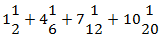 .......... upto 20 terms?
Show answer & explanation
Q18. Geometry · Tier 2, 21 February 2018
The angles of elevation of the top of a tower 72 metre high from the top and bottom of a building are 30° and 60° respectively. What is the height (in metres) of building?
Show answer & explanation
Q19. Profit, loss and discount · Tier 2, 21 February 2018
A used two-wheeler dealer sells a scooter for Rs 46,000 and makes some loss. If he had sold it for Rs 58,000 his profit would have been double his loss. What was the cost price (in Rs) of the scooter?
Show answer & explanation
Q20. Algebra · Tier 2, 21 February 2018
If x3 – 4x2 + 19 = 6(x – 1), then what is the value of [x2 + (1/x – 4)]?
Show answer & explanation
All 5 SSC CGL 2018 shifts with Quantitative Aptitude questions
- Tier 2, 17 February 2018100 Maths questionsPractise
- Tier 2, 19 February 2018100 Maths questionsPractise
- Tier 2, 20 February 2018100 Maths questionsPractise
- Tier 2, 21 February 2018100 Maths questionsPractise
- Tier 2, 9 March 2018100 Maths questionsPractise
More SSC CGL practice
Other SSC CGL 2018 subjects
SSC CGL Quantitative Aptitude in other years
See every SSC CGL year and subject on the SSC CGL previous year papers page, or the SSC CGL 2018 papers.