SSC CHSL 2021 PYQ — Question 64

SSC CHSL - 12 April 2021 - Shift 3 • Quantitative Aptitude • Q64

Comprehension:
In the following passage, some words have been deleted. Select the most appropriate option
to fill in each blank.
In the 19th century, there was an industrial revolution in Europe. As a result, millions of people
left the (1) ______ and went to work in big factories in cities. Today, it is the reverse. In several
major cities, people have started moving out. Why? They want a cleaner, (2) ______
environment. There are fewer jobs in ‘heavy’ industries like steel and power generation. (3)
______, there are more jobs in service industries like banking, tourism and food delivery.
Besides, modern transport and communications have made it easier for people to (4) ______
to work or even work from home. The result of this revolution in the 21st century will be
‘spread cities’ – cities are growing fast, but (5) ______, away from city centres and people are
choosing to live 40, 50 or 60 kilometres away.

Study the given bar chart and answer the question that follows.

The bar chart shows the production of medicines by a company (in 1000 tonnes) over six years 2010 to 2015.
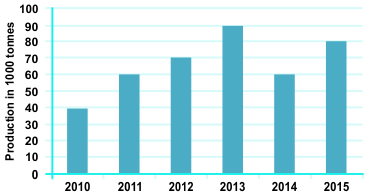
If in each of the following years, the percentage increase in production as compared to the previous year is taken, then the ratio for increase production of the year 2011 to increase production of year 2015 is:

Show answer & explanation

Correct answer: D

Explanation

The correct answer in option 4 i.e. 3:2

Percent increase in production of medicines of the year 2011 = (60 - 40)/40 × 100 = 20/40 × 100 = 50%

Percent increase in production of medicines of the year 2015 = (80 - 60)/60 × 100 = 20/60 × 100 = 100/3%

The ratio will be 50% : 100/3%

⇒ 1 : 2/3

⇒ 3 : 2