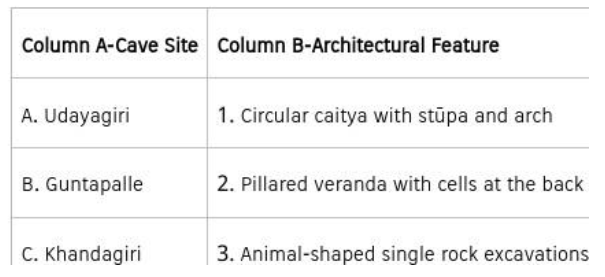
Match the following cave sites with their architectural characteristics:
Show answer & explanation
Correct answer: D
Explanation
Answer: A - 2, B - 1, C – 3
Explanation
The cave architecture of India during the ancient period was primarily religious in nature.
A. Udayagiri (Odisha) → 2. Pillared veranda with cells at the back: These are Jain caves located near Bhubaneswar. The typical architecture here involves a long open veranda supported by pillars, with small dwelling cells (monastic rooms) excavated into the rock behind the veranda for Jain monks.
B. Guntapalle (Andhra Pradesh) → 1. Circular caitya with stupa and arch: This site is often called the 'Ajanta of Andhra.' It features a rare circular rock-cut chaitya (prayer hall) that houses a stupa and has a distinct arched entrance, reflecting early Buddhist rock-cut design.
C. Khandagiri (Odisha) → 3. Animal-shaped single rock excavations: Khandagiri is adjacent to Udayagiri. Some caves here, like the famous Vyaghra Gumpha (Tiger Cave), are carved in the shape of animal heads or specific animal forms, making them unique in the rock-cut tradition.
2. Key Facts for Exams
Hathigumpha Inscription: Located in Udayagiri, this is the main source of information about King Kharavela.
Religious Affiliation: Udayagiri and Khandagiri are primarily Jain, whereas Guntapalle is Buddhist.
Architecture Evolution: The circular chaitya at Guntapalle is an architectural precursor to the more complex rectangular chaityas seen later in sites like Karle and Bhaja.
Exam-Related Practice Questions
Q: The famous 'Hathigumpha' (Elephant Cave) inscription, which provides a chronological record of King Kharavela's reign, is located in which cave site?
Answer: Udayagiri (Odisha).
Q: Which of the following cave sites is specifically known for its early Buddhist 'Circular Chaitya' structure?
Answer: Guntapalle Caves.