Which of the following number is divisible by 9?
SSC MTS 2026
SSC MTS 2026 Quantitative Aptitude (Maths) Previous Year Questions
664 questions from 36 shifts, sorted by topic, free to practise.
- Questions
- 664
- Shifts
- 36
- Per shift (median)
- 19
- Topics found
- 14
About the SSC MTS 2026 Quantitative Aptitude questions
The quantitative aptitude section tests arithmetic (percentages, profit and loss, interest, ratio, averages, time and work, speed and distance), advanced maths (algebra, geometry, mensuration and trigonometry) and data interpretation. This page brings together all 664 Quantitative Aptitude questions from the 36 SSC MTS 2026 shifts on SarkariPYQ, held between 4 February 2026 and 20 February 2026. A typical shift has 19 Quantitative Aptitude questions. The most frequent question types are number system (76), averages (72) and data interpretation (67).
In SSC MTS Session I (computer-based), the Numerical & Mathematical Ability section has 20 questions for 60 marks, 3 marks per question; negative marking: none. The whole Session I (computer-based) paper is 40 questions for 120 marks in 45 minutes. The pattern can change between cycles, so confirm it in the latest notification on ssc.gov.in.
16% of these questions come with a figure or a table. Start with the sample questions below, picked from the most common topics, or open any shift to practise all of its Quantitative Aptitude questions in order. The answer and explanation of each question stay hidden until you attempt it.
SSC MTS 2026 Maths questions by topic
| Topic | Questions | Share |
|---|---|---|
| Number system | 76 (11%) | |
| Averages | 72 (11%) | |
| Data interpretation | 67 (10%) | |
| Profit, loss and discount | 48 (7%) | |
| Percentages | 39 (6%) | |
| Geometry | 37 (6%) | |
| Simplification | 32 (5%) | |
| Speed, distance and time | 32 (5%) | |
| Time and work | 24 (4%) | |
| Mensuration | 23 (3%) | |
| Ratio and proportion | 21 (3%) | |
| Interest (simple and compound) | 18 (3%) | |
| Algebra | 13 (2%) | |
| Mixtures and alligation | 11 (2%) | |
| Other / mixed | 151 (23%) |
Topics are read from each question's wording by keyword rules; a question that matches no rule is counted under “Other / mixed” rather than guessed.
Practise 20 SSC MTS 2026 Maths questions
Picked across the most common topics and different shifts. Choose an option to see whether you were right; the answer and explanation load only then.
Q1. Number system · 20 February 2026 Shift 2
Q2. Averages · 20 February 2026 Shift 2
If 20a + 20b = 160, then what is the average of a and b?
Show answer & explanation
Q3. Data interpretation · 20 February 2026 Shift 2
The table given below shows the number of cars (M1) and number of bikes (M2) parked in 4 parking areas A, B, C and D. Number of bikes parked are shown as a percent of total number of vehicles (cars and bikes) parked in the parking area.
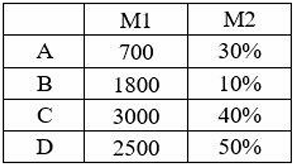
What are the total number of vehicles (bikes and cars) parked in A and B together?Show answer & explanation
Q4. Profit, loss and discount · 20 February 2026 Shift 2
The ratio of selling price of an article to the cost price of the article is 9 : 11. What is the loss percentage?
Show answer & explanation
Q5. Percentages · 20 February 2026 Shift 2
The line chart given below shows the total number of athletes representing a country in 5 consecutive Asian Games AG1, AG2, AG3, AG4 and AG5.
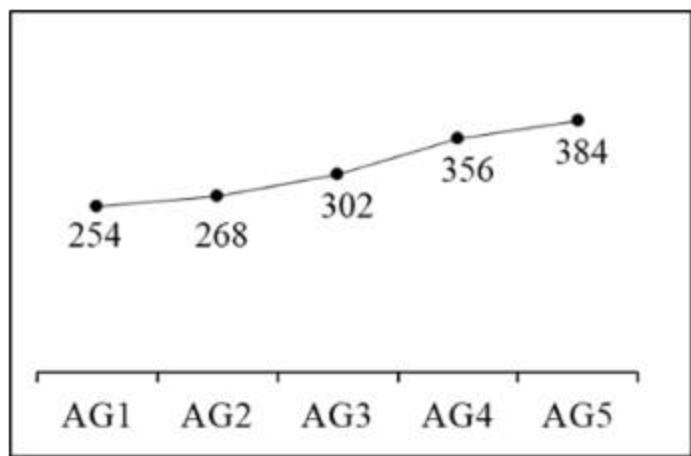
Compared to the immediately preceding Asian Games, which Asian Games witnessed the highest percentage increase in the number of athletes?
Show answer & explanation
Q6. Geometry · 20 February 2026 Shift 2
Two circles have centers M and N with radii 10 cm and 6 cm, respectively. The distance MN is 13 cm. QR is a common external tangent to both circles. What is the length of QR? (the segment between the points of tangency)
Show answer & explanation
Q7. Simplification · 20 February 2026 Shift 2
((√10 + √3)² + (√10 − √3)²) / 26 = ?
Show answer & explanation
Q8. Speed, distance and time · 20 February 2026 Shift 2
The speed of a train is 36 km/hr. Length of the train is 100 metres. In how much time (in seconds) it will cross a platform of length 200 metres?
Show answer & explanation
Q9. Time and work · 20 February 2026 Shift 2
A is 4 times as good a workman as B. A and B together can finish a work in 20 days. In how many days will B alone complete the same work?
Show answer & explanation
Q10. Mensuration · 20 February 2026 Shift 2
The breadth of a rectangular hall is 8/3 of its length. The area of the floor is 96 square metre, then what is the difference (in metre) between the length and breadth of the hall?
Show answer & explanation
Q11. Ratio and proportion · 20 February 2026 Shift 1
The length of a rectangle is 7 cm. The diagonal of the rectangle is 25 cm. What is the ratio of length and breadth of the rectangle?
Show answer & explanation
Q12. Interest (simple and compound) · 19 February 2026 Shift 3
At a local book club, Arjun lent ₹4,800 to his friend at a simple interest rate of 7.5% per annum. After some time, he received ₹6,000 in total from his friend. Find the time period (in years) for which the money was lent.
Show answer & explanation
Q13. Algebra · 19 February 2026 Shift 2
If x = √144 × √81 + √169, then what is the value of x?
Show answer & explanation
Q14. Mixtures and alligation · 20 February 2026 Shift 1
A container initially holds 80 litres of a mixture of milk and water in the ratio 3:1. From this container, 16 litres of the mixture is removed and replaced entirely with pure water. This process is repeated one more time. What is the final quantity of milk (in litres) remaining in the container?
Show answer & explanation
Q15. Other / mixed · 20 February 2026 Shift 2
2[710² + 690²] − (710 + 690)² = ?
Show answer & explanation
Q16. Number system · 20 February 2026 Shift 1
Which of the following number is divisible by both 4 and 9?
Show answer & explanation
Q17. Averages · 20 February 2026 Shift 1
9 numbers are in arithmetic progression. Average of first and last number of this progression is 13. What is the average of these 9 numbers?
Show answer & explanation
Q18. Data interpretation · 19 February 2026 Shift 3
The pie chart given below shows the daily water usage (in units) in a city by the 6 sectors. The data is presented in the terms of percent.
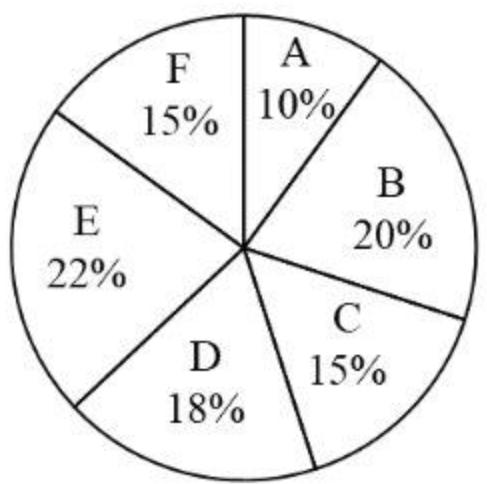
What is the difference between (in degrees) the central angle formed by the sectors of E and D?Show answer & explanation
Q19. Profit, loss and discount · 20 February 2026 Shift 1
Selling price of an article is Rs. 306. Loss percentage is 40 percent. What is the cost price of the article?
Show answer & explanation
Q20. Percentages · 20 February 2026 Shift 1
When 4 percent of a number is added to 11 percent of the same number, then the result is 1845. What is the value of the number?
Show answer & explanation
All 36 SSC MTS 2026 shifts with Quantitative Aptitude questions
- 4 February 2026 Shift 322 Maths questionsPractise
- 5 February 2026 Shift 118 Maths questionsPractise
- 5 February 2026 Shift 218 Maths questionsPractise
- 5 February 2026 Shift 317 Maths questionsPractise
- 6 February 2026 Shift 117 Maths questionsPractise
- 6 February 2026 Shift 220 Maths questionsPractise
- 6 February 2026 Shift 318 Maths questionsPractise
- 9 February 2026 Shift 120 Maths questionsPractise
- 9 February 2026 Shift 219 Maths questionsPractise
- 9 February 2026 Shift 318 Maths questionsPractise
- 10 February 2026 Shift 120 Maths questionsPractise
- 10 February 2026 Shift 218 Maths questionsPractise
- 10 February 2026 Shift 318 Maths questionsPractise
- 11 February 2026 Shift 120 Maths questionsPractise
- 11 February 2026 Shift 211 Maths questionsPractise
- 11 February 2026 Shift 319 Maths questionsPractise
- 12 February 2026 Shift 120 Maths questionsPractise
- 12 February 2026 Shift 218 Maths questionsPractise
- 12 February 2026 Shift 317 Maths questionsPractise
- 13 February 2026 Shift 121 Maths questionsPractise
- 13 February 2026 Shift 218 Maths questionsPractise
- 13 February 2026 Shift 318 Maths questionsPractise
- 16 February 2026 Shift 120 Maths questionsPractise
- 16 February 2026 Shift 215 Maths questionsPractise
- 16 February 2026 Shift 320 Maths questionsPractise
- 17 February 2026 Shift 119 Maths questionsPractise
- 17 February 2026 Shift 220 Maths questionsPractise
- 17 February 2026 Shift 315 Maths questionsPractise
- 18 February 2026 Shift 120 Maths questionsPractise
- 18 February 2026 Shift 211 Maths questionsPractise
- 18 February 2026 Shift 320 Maths questionsPractise
- 19 February 2026 Shift 120 Maths questionsPractise
- 19 February 2026 Shift 219 Maths questionsPractise
- 19 February 2026 Shift 320 Maths questionsPractise
- 20 February 2026 Shift 120 Maths questionsPractise
- 20 February 2026 Shift 220 Maths questionsPractise
More SSC MTS practice
Other SSC MTS 2026 subjects
SSC MTS Quantitative Aptitude in other years
2026 Quantitative Aptitude in other SSC exams
See every SSC MTS year and subject on the SSC MTS previous year papers page, or the SSC MTS 2026 papers.