Two statements are given, followed by four conclusions numbered I, II, III, and IV. Assuming the statements to be true, even if they seem to be at variance with commonly known facts, decide which of the conclusions logically follow from the statements.
Statements:
Some goats are animals.
No animal is a bird.
Conclusions:
I. No animal is a goat.
II. No bird is a goat.
III. Some birds are goats.
IV. Some animals are goats.
Show answer & explanation
Correct answer: A
Explanation
The correct answer is option 1, i.e., either Conclusion II or III, and Conclusion IV follows.
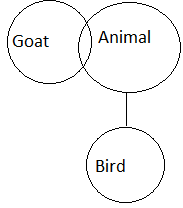
Conclusions:
I. No animal is a goat → Does not follow (This contradicts statement 1, which says some goats are animals.)
II. No bird is a goat → Follows (The statements say "No animal is a bird" and "Some goats are animals," but we cannot conclude anything about goats and birds directly. There is no direct relation between goats and birds stated.)
III. Some birds are goats → Follows (There's no information supporting this. Based on the statements, birds are entirely separate from animals, and since goats are (at least partially) animals, they likely aren't birds either. But this cannot be concluded, so it's not logically valid.)
IV. Some animals are goats → Follows (This is exactly what Statement 1 says: “Some goats are animals” is logically equivalent to “Some animals are goats.”)