Directions: Below are given two statements and four conclusions I, II, III and IV. Assuming the statements to be true, even if they seem to be at variance with commonly known facts, decide which of the conclusions logically follows from the statements.
Statements:
All trains are scooters.
All buses are scooters.
Conclusions:
I. Some scooters are trains.
II. No trains are buses.
III. Some trains are buses.
IV. No scooters are trains.
Show answer & explanation
Correct answer: B
Explanation
The correct answer is option 2 i.e. Conclusion I and either conclusion II or III follow.
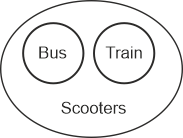
Conclusions:
I. Some scooters are trains → Follows (As all trains are scooters, so some scooters are trains is true.)
II. No trains are buses → Does not follow (It is possible but not definite.)
III. Some trains are buses → Does not follow (It is possible but not definite.)
IV. No scooters are trains → Does not follow (As all trains are scooters, so no scooters are trains is not true.)
Here, Conclusions II and III form a complementary pair, so Conclusion I and either Conclusion II or III follow.